
How crafting works in Casualties: Unknown: the five tabs, Intelligence requirements, failure tiers, blueprints and the recipes worth making first.
Casualties: Unknown Crafting Guide and Recipe Rules
Crafting is how you stop depending on loot. In Casualties: Unknown, the cave gives you plants, plastic, wood and ore; the crafting menu turns them into bags, bandages, tools and medicine. The system is simple to open and easy to get wrong: the Intelligence requirement on each recipe is not a suggestion, and a failed craft can cost you health.
Official source: Casualties: Unknown on Steam ↗
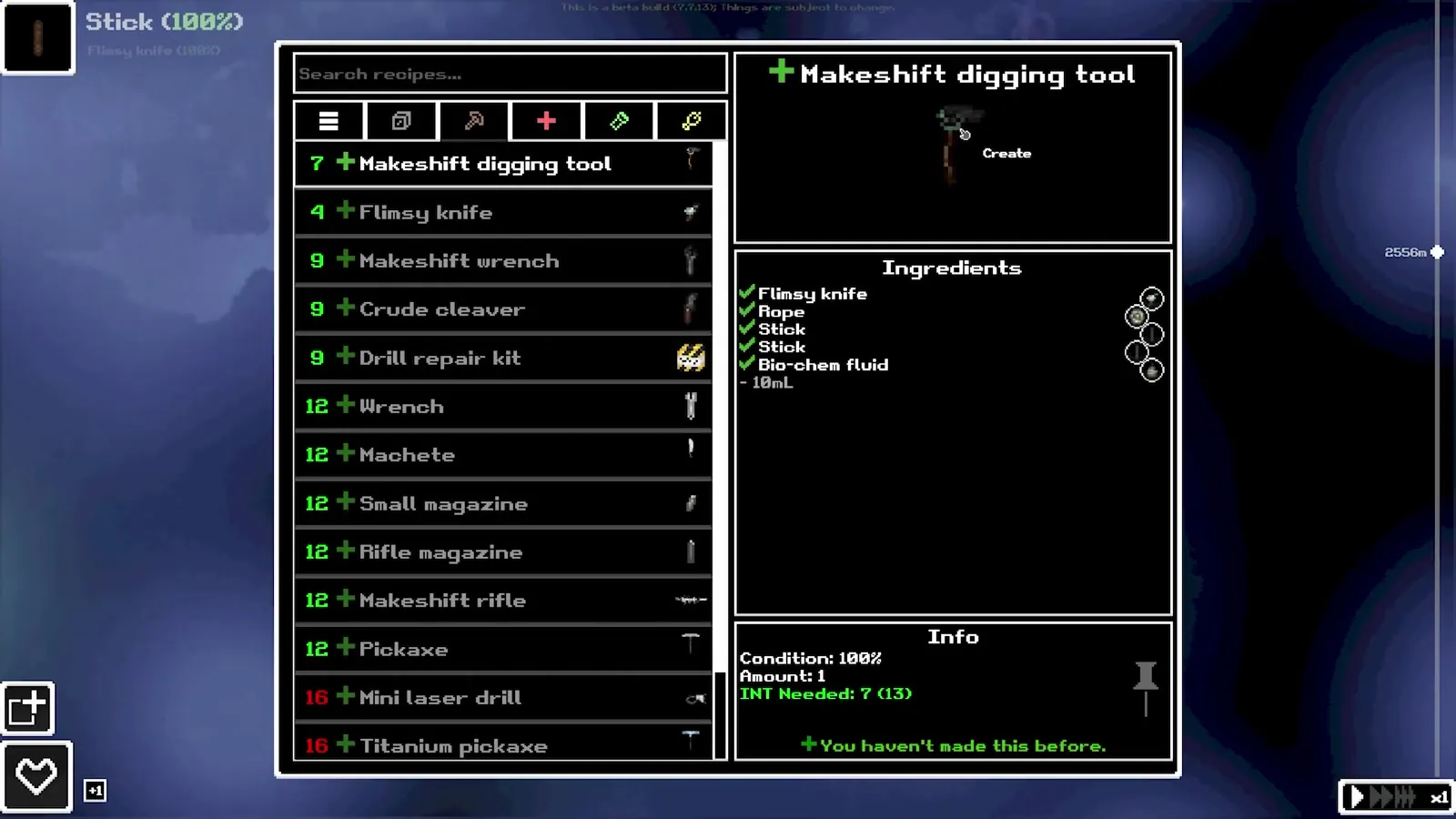
Opening the menu
Press C. The menu has five tabs:
- Materials: rope, canvas, string, nails, scrap panels, batteries.
- Tools: digging tools, knives, lockpicks, repair tools.
- Medicine: bandages, dressings, splints, antiseptic, procoagulant.
- Utilities: bags, lights, containers, campfires.
- Food: soups, juices, cooked meals.
Items used in a craft do not need to be in your inventory; they need to be nearby and not blocked by a wall. This is why a workbench area next to storage is more efficient than crafting from your pockets.
Intelligence requirements
Every recipe has a minimum INT level. The number is colour-coded against your current INT:
| Colour | Deficit | Result |
|---|---|---|
| Green | At or above | Craft succeeds |
| Yellow | 1 level short | 50% chance of minor failure |
| Orange | 2 levels short | 50% chance of major failure |
| Red | 3 levels short | 50% chance of critical failure |
| Hidden | 4+ levels short | Recipe not shown |
A Blueprint sets the INT requirement of one random recipe to 0. That is the single most valuable INT item in the game, because it turns a red recipe green permanently.
Failure tiers
- Minor failure: item condition drops by 10–90%, including liquid volume and battery charge. If the recipe makes several items, all of them share the same penalty.
- Major failure: no item is produced.
- Critical failure: no item, plus +40 pain, -15 skin health and about 0.0525 L/m bleeding to each hand.
That is why you do not spam red recipes. Two critical failures can put both hands into a state where you cannot bandage the damage you just caused.
Minor failure has an average condition penalty of about 25% once the 50% success chance is included. A yellow recipe is usable; an orange or red recipe is a gamble.
First crafts
The opening progression is fixed:
- Rope — 2 Foliage.
- Canvas — 3 Foliage each.
- Foliage bag — 1 Rope + 2 Canvas.
- Canteen — 2 Chunk of plastic + 1 Rope + 10 mL Bio-chem fluid.
Harvest Glowplants and Geotrees for foliage. Craft rope and canvas as you gather, because they stack better than raw foliage. The Foliage bag is the first real capacity upgrade; favorite it so you do not accidentally consume it in a recipe.
Bio-chem fluid comes from Glowplant fruits. Break the fruit, craft the fluid, then craft the canteen.
The recipes that matter
Mobility and storage
- Foliage bag: the first container, cheap and light.
- Trauma rig: requires a belt, but occupies the torso-front slot, so you can wear a belt and a rig at the same time. It is the best combat container.
- Sling bag / small backpack: early alternatives if you find cloth.
Medicine
- Bandage: the basic bleed stopper.
- Dressing: four canvases; a full dressing weighs 0.9 u, while the canvases weigh 0.4 u. Craft dressings at base, carry one.
- Splint: wood plus cloth, for fractures.
- Procoagulant: from Bunchunk, for internal bleeding support.
- Antiseptic: plant-based; use it before infection starts.
Tools
- Makeshift digging tool: your first real pick. Favorite it, or it will be consumed by hammering and cutting recipes.
- Pickaxe: upgrade from the makeshift tool; keep the old one at 1% durability as an ingredient.
- Lockpick: INT-dependent; useful for vaults and crates.
- Repair tool: keeps armour and weapons alive between traders.
Liquids and power
- IV bag: the best liquid storage in the game. Keep at least four: bio-chem, crafting materials, soup, produce juice.
- Blood bag: draw your own blood for emergencies.
- Medium battery: craft a full medium battery from two empty small batteries. Upgrade your flashlight as soon as you can.
Recipe pinning and favouriting
Two UI habits save runs:
- Pin a recipe with the pin icon in the bottom-right of the crafting menu. The recipe stays on the top-left of the screen, so you can gather toward it without reopening the menu.
- Favorite tools and bags so the crafting system does not consume them as ingredients. A favourite item is protected from being used in a recipe.
The makeshift digging tool is the classic victim. It counts as a hammer, a cutting tool and a digging tool, so it gets eaten by recipes unless you favourite it.
What not to craft
- Red recipes with both hands injured. You cannot treat the critical-failure bleed reliably.
- Duplicate tools. One pickaxe, one knife, one repair tool. Weight is the real cost.
- Food you will not eat. Soup is heavy and spoils the value of the ingredients if you are about to descend.
- A second backpack. Containers do not nest; use a belt or pouch instead.
Crafting and INT progression
Every first-time craft gives +10 INT XP and +1 Mood. That makes cheap, useless recipes a legitimate way to train INT: craft one of everything you can, once, and the levels come.
Blueprints give +25 INT XP on reading, and E-PDAs give +35. A single E-PDA is worth more than two first-time crafts. Pick them up, read them, and wrench the battery out afterward.
A crafting route for the first hour
- Harvest 12–15 foliage.
- Craft rope and canvas.
- Craft a Foliage bag.
- Craft a canteen and fill it.
- Craft bandages.
- Craft a makeshift digging tool.
- Craft a splint and keep it.
- Pin the next upgrade you want.
That route leaves you with a bag, water, a weapon, a bandage and a splint before the first real fight. It is the difference between a run and a learning experience.
A makeshift digging tool counts as a hammer and a cutting tool. Without a favourite, a recipe will eat it.
FAQ
Why can't I craft a recipe? Your INT is four or more levels below the requirement, so the recipe is hidden. Raise INT with E-PDAs, blueprints and first-time crafts.
What happens if I craft a yellow recipe? There is a 50% chance of minor failure, which reduces condition or volume by 10–90%.
Can crafting kill me? A critical failure damages both hands and causes bleeding. It is rarely fatal alone, but it can be if you cannot bandage.
Do I need materials in my inventory? No. They need to be nearby and not blocked by a wall.
What does a blueprint do? It sets one random recipe's INT requirement to 0.
Should I craft everything once? Yes, for the INT XP and mood, as long as the recipe is green or yellow.
Sources and further reading
Related guides
More Casualties: Unknown Guides
Every weapon in the Casualties: Unknown demo ranked: damage, swing speed, durability, ammo and which weapon fits which layer.
How blood volume, bleeding rate, tourniquets and transfusions work in Casualties: Unknown, and the order to treat a bleeding limb.
The three playable characters in Casualties: Unknown, what Experiment can do in the demo, and what is actually confirmed about Milky and Dune.
What the free Casualties: Unknown demo includes, how long it takes, where it ends, what carries over and how to install it on Steam.
All six Casualties: Unknown presets plus the 41 custom run settings, with defaults, ranges and the options that actually change survival.
Casualties: Unknown endings explained: the confirmed story goal, the unreleased final layers, what the demo does at layer 5, and what is still speculation.
Every enemy in Casualties: Unknown, its layer, attack pattern and drops, plus the Elder Thornback fight and the traps that kill more players than monsters.
A practical triage guide for Casualties: Unknown: bleeding, infection, fractures, pain shock, fibrillation and the items that treat each condition.