
How blood volume, bleeding rate, tourniquets and transfusions work in Casualties: Unknown, and the order to treat a bleeding limb.
Casualties: Unknown Bleeding Guide: Stop the Blood Loss
Bleeding is the leading cause of death in Casualties: Unknown, and it is the system the game simulates most literally. Blood volume is tracked in litres, bleeding is tracked in litres per minute, and consciousness fails before the heart does.
The mistake new players make is treating bleeding as a number to worry about later. It is a clock. A limb bleed of 0.5 L/m empties a meaningful share of your blood volume in minutes, and the treatment is usually one bandage applied in the right order.
Official source: Casualties: Unknown on Steam ↗
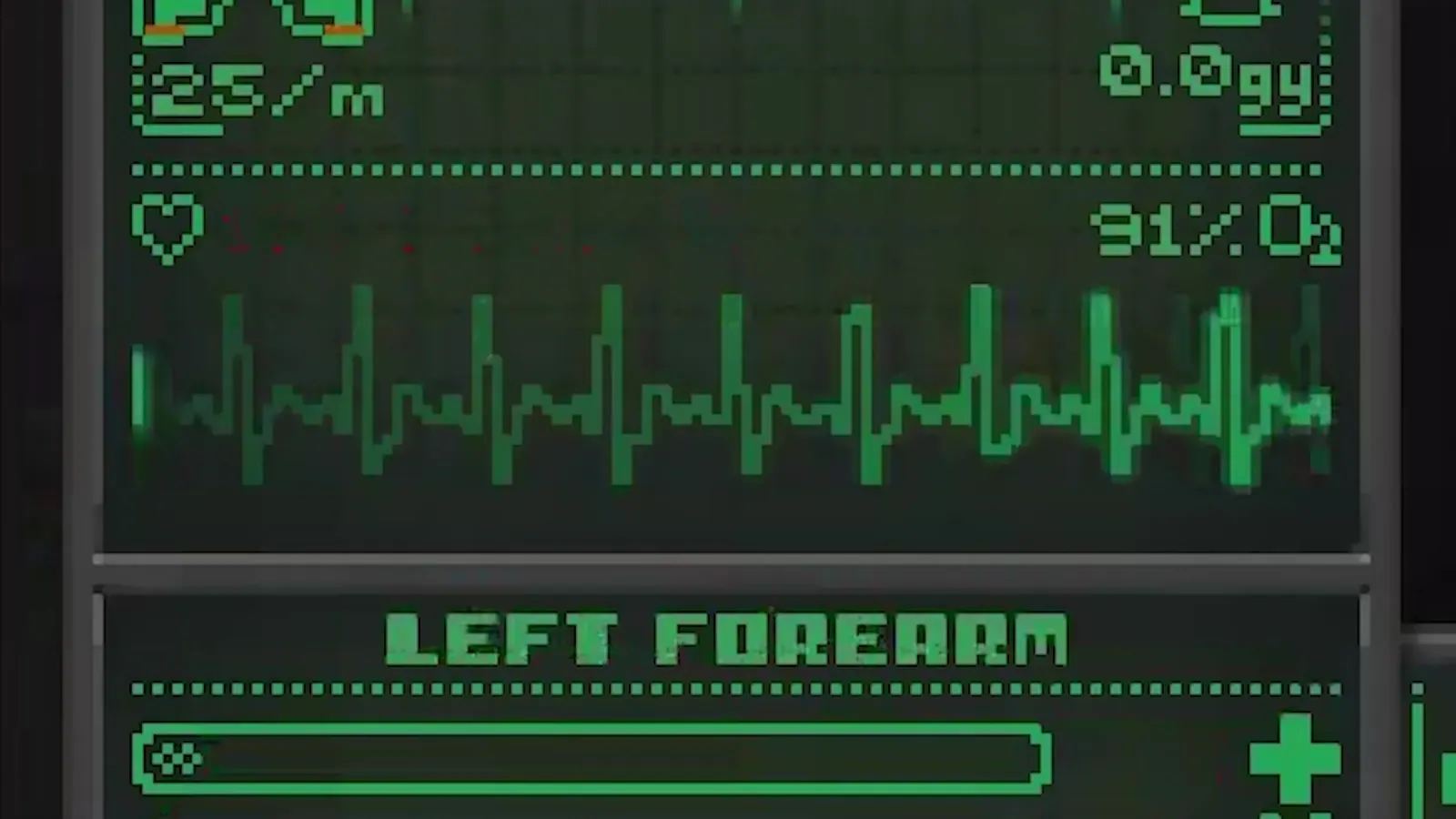
Blood volume
The body holds up to 7.5 L, with a resting volume of 5.00 L. Every 125 mL away from that resting value shifts immunity and mood by 1 point. That means blood loss is not just a death timer; it also suppresses your immune response and your mental state.
At 3 L or below, oxygen saturation begins to fall. Below that, the character's consciousness drops, and the dying state begins when brain integrity reaches zero. Once you are in that state, brain integrity falls about 5.25% per real second, which gives roughly 19 seconds before death. That is the window for CPR, a defibrillator or an auto-pump.
How bleeding is calculated
The game adds up:
- External bleeding from each limb.
- Internal bleeding from organs and torso damage.
- Natural clotting, which removes a small amount over time.
The result is your bleeding rate in L/m. A wound that looks minor on the health panel can still be lethal if it is arterial or if several limbs are bleeding at once.
The health panel lists each limb's skin and muscle health. Skin health determines infection risk and persistent pain; muscle health determines limb strength. A limb at zero muscle is useless even if it is still attached.
Treatment order
Treat in this order:
- Stop the bleed. Bandage or dressing on the wound. A dressing is better than a bandage for a deep wound.
- Tourniquet only for a limb you cannot stop. A tourniquet stops arterial flow, but after 9 minutes it guarantees infection. Note the time.
- Replace volume. Blood bag or IV bag once the bleeding is controlled. Transfusing before stopping the bleed wastes the bag.
- Treat infection. Antiseptic, antibiotics or relief cream, depending on the wound.
- Treat pain. Pain shock above 0.66 drops consciousness to zero regardless of blood volume.
Do not tourniquet a limb and then forget it. The infection from a forgotten tourniquet is worse than the bleed it stopped.
Bandage, dressing or tourniquet?
| Item | Use | Limitation |
|---|---|---|
| Bandage | Small cuts, low flow | Not enough for arterial bleeding |
| Sterilized dressing | Deep or dirty wounds | Bulkier and heavier |
| Tourniquet | Arterial limb bleed | Infection after 9 minutes |
| Procoagulant | Internal bleeding support | Crafted from Bunchunk |
A full dressing weighs 0.9 u, while four canvases weigh 0.4 u. Carry one dressing and craft replacements as needed; do not haul a stack of dressings through five layers.
Internal bleeding
Internal bleeding is the silent killer. You cannot bandage it, and the health panel shows it as a separate line. Sources include blunt torso trauma, falls, explosions and the Elder Thornback.
Treatment:
- L.R.D. (liquid) is the dedicated internal-bleeding treatment.
- Helluce is an alternative.
- Procoagulant supports clotting and is crafted from Bunchunk, dropped by Fungali bungali in the Fungal Pools.
- Surgery is required for some organ damage; the demo's medical loop includes it.
If internal bleeding is climbing and you have no L.R.D., your options are to reach a trader, reach the life-pod, or accept that the run is over. Do not keep descending.
Blood pressure and consciousness
Blood pressure is derived from volume, vessel tone and heart function. Vessels constrict or dilate by up to 15%, which is why the same wound can produce different symptoms on different runs.
When pressure falls far enough, the character faints. Fainting in a safe pod is recoverable. Fainting on a spike trap is not. If you feel the screen darkening, stop moving, sit down and treat the bleed before you climb.
Transfusion
Blood bags hold 750 mL. IV bags hold 750 mL and are the best liquid storage in the game for medicine.
To transfuse:
- Control the bleeding first.
- Open the health panel and select the blood bag or IV bag.
- Apply it to the patient.
- Re-check blood volume; do not over-transfuse past the safe range.
You can draw your own blood with a blood bag. Red blood bags are also used to enter bio-terminals; draining the red blood into another container gives you an empty bag for your own use.
Bleeding and infection
Every open wound is an infection roll. The chance is calculated from skin health: at 80 skin health the roll is near zero, at 60 it is about 5.75%, at 40 about 11.5%, at 20 about 17.25%, and at 0 about 23%. The check runs every 40 seconds while skin is below 80.
That is why a dirty, low-skin limb needs antiseptic, not just a bandage. Cleaning the wound lowers the infection roll; ignoring it guarantees a second problem.
When to amputate
Amputation is the last resort for a limb that is destroyed, crushed or permanently infected. The demo includes the surgery loop: anaesthetic, saw, tourniquet and dressing.
Amputate when:
- The limb's muscle health is zero and it cannot be saved.
- Infection is systemic and the limb is the source.
- The limb is trapping you and the alternative is death.
Do not amputate a limb you can splint. A broken leg is a mobility problem; a missing leg is a permanent one.
Bleeding by enemy
| Enemy | Bleed risk | Note |
|---|---|---|
| Cave tick | Low | Infection risk from the bite |
| Sand stalker | Medium | Ambush in Dried Desert |
| Shade crawler | Medium | Common in layers 1–5 |
| Thornback | High | Dismemberment and heavy bleeding |
| Elder Thornback | Extreme | Can remove a limb outright |
| Trader (hostile) | High | Bullets cause deep wounds |
The enemies guide covers each one's attack pattern.
A bleeding checklist
- Apply pressure or a bandage immediately.
- Check the health panel for internal bleeding.
- Note tourniquet time.
- Transfuse only after the bleed stops.
- Clean the wound with antiseptic.
- Treat pain before it reaches shock.
- Do not descend until the bleeding rate is zero.
Nine minutes after application, infection is guaranteed. Write the time down or do not apply one.
FAQ
How much blood can you lose? The body holds up to 7.5 L and rests at 5.00 L. Symptoms scale with the deficit; 3 L is the danger zone.
How long does a tourniquet last? Nine minutes before infection is guaranteed. Treat it as a timer, not a permanent fix.
Can you stop internal bleeding with a bandage? No. Internal bleeding needs L.R.D., Helluce, procoagulant or surgery.
What is the fastest way to restore blood? A blood bag or IV bag after the bleeding is controlled.
Does bleeding affect immunity? Yes. Every 125 mL from the resting volume shifts immunity and mood by 1.
Sources and further reading
Related guides
More Casualties: Unknown Guides
Every weapon in the Casualties: Unknown demo ranked: damage, swing speed, durability, ammo and which weapon fits which layer.
The three playable characters in Casualties: Unknown, what Experiment can do in the demo, and what is actually confirmed about Milky and Dune.
How crafting works in Casualties: Unknown: the five tabs, Intelligence requirements, failure tiers, blueprints and the recipes worth making first.
What the free Casualties: Unknown demo includes, how long it takes, where it ends, what carries over and how to install it on Steam.
All six Casualties: Unknown presets plus the 41 custom run settings, with defaults, ranges and the options that actually change survival.
Casualties: Unknown endings explained: the confirmed story goal, the unreleased final layers, what the demo does at layer 5, and what is still speculation.
Every enemy in Casualties: Unknown, its layer, attack pattern and drops, plus the Elder Thornback fight and the traps that kill more players than monsters.
A practical triage guide for Casualties: Unknown: bleeding, infection, fractures, pain shock, fibrillation and the items that treat each condition.